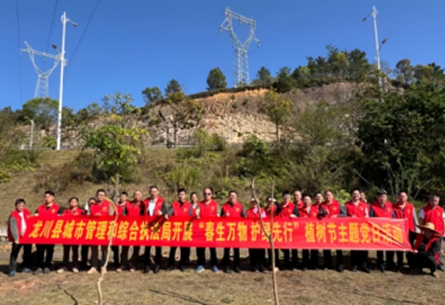
In 2024, the Group’s projects across various regions implemented the “Green mountains and clear waters are as valuable as gold and silver” concept, joining hands with children, employees, and other enterprises to actively participate in tree-planting activities. Our Zibo Garden Project organized the activity “Big hands hold little hands, welcoming spring and adding new greenery”, leading children to experience the joy of tree planting. The Longchuan Project responded to the call of Green and Beautiful Guangdong, planting 1,000 purple osmanthus seedlings to add greenery and color to Longchuan. The Ganhe Industrial Park Project, in cooperation with the park and enterprises, organized over 300 people to participate in voluntary tree-planting activities, providing professional guidance and material support throughout the process.
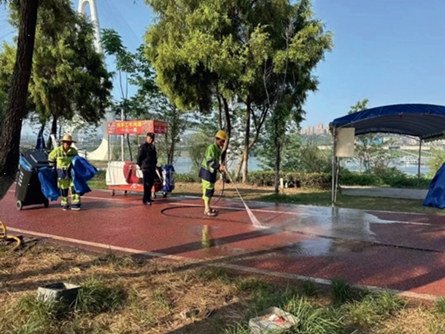
In 2025, to enhance the level of refined management and maintenance and create a cleaner and more beautiful urban public environment, the Group’s Banan Project Company launched a comprehensive improvement campaign to enhance the quality of Yangchun Wetland Park. Building upon our routine cleaning protocols, we strictly followed a combined process of “sweeping, hosing down, scrubbing, washing, and wiping” to conduct meticulous deep cleaning of hard-to-reach areas such as park pathways, drainage ditches along green belts, tree rings, and brick joints. We also carried out concentrated scrubbing and wiping of trash bins, facilities, guardrails, benches, and signage. Concurrently, we carried out a special environmental sanitation campaign along Babin Road. This initiative ensured the park was “free of trash, stains, and dust, revealing its original colors and presenting a fresh new look.” A total of over 100 person-shifts were deployed to clean approximately 1,000 square meters of sidewalks, roadways, and green belts, removing about 0.2 tons of trash, trimmed 6,000 square meters of shrubs, cleared 11,500 square meters of weeds, mowed 5,500 square meters of lawn, replenished 480 square meters of lawn soil, and hosed down approximately 3,000 square meters of pavement.
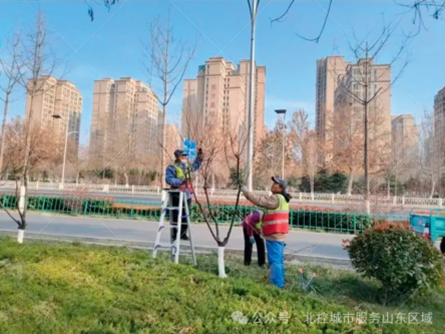
During the critical winter maintenance period of 2025, our Group’s Shandong region has been systematically advancing precision maintenance work at the Zibo landscaping project. We organized staff to remain on duty, conducting safety inspections across the managed areas with a focus on clearing flammable materials such as dead branches and fallen leaves to strictly prevent fires. At the same time, we seized the optimal window for winter pruning to perform scientific shaping and trimming on evergreen plants and various flowering shrubs, removing diseased and weak branches while sculpting attractive forms in accordance with the plants’ natural growth patterns. Through these measures, we effectively eliminated fire hazards in green spaces, ensuring the safety of landscaping and the integrity of the landscape during the holiday season. The pruning work has enhanced the plants’ cold resistance and improved the overall aesthetic quality of the landscape, laying a solid foundation for the plants to survive the winter and thrive in the coming year.
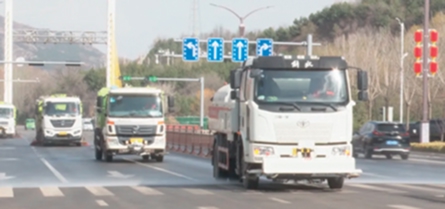
In 2025, in response to strong winds and sandstorms, the Group’s North China Region and Shun Project immediately activated emergency response plans, intensifying cleaning and dust suppression efforts to ensure a clean urban environment. We deployed 3 water sprinkler trucks and 3 street sweeper-washers to conduct 3 rounds of wet sweeping and 6 rounds of dust suppression operations on the main streets of the county’s urban area. Through back-and-forth patrols using water sprinkler trucks and wet sweepers, and by deploying all available water-carrying sanitation vehicles, we intensified mechanized operations such as dust suction, street sweeping, misting, and washing to minimize the impact of sand and dust to the greatest extent possible. These operations effectively suppressed road dust, accelerated the settling of sand and dust, and created a clean and comfortable living environment for citizens. In the future, our Group will continue to adjust operation frequencies based on temperature and weather changes, adopt a combination of manual and mechanical methods, and intensify high-density water spraying and dust suppression in key areas to promote continuous improvement in air quality.
The Group continues to deepen the integrated application of green energy and clean technologies. Through operational optimization and technological innovation, we provide sustained momentum to advance the implementation of the “Dual Carbon” goals and fulfill our commitment to sustainable development.
• Promotion of New Energy Vehicles and Smart Management:
In our Shenzhen projects, we are continuously expanding the scale of new energy sanitation vehicle deployment and comprehensively advancing the low-carbon transformation of sanitation operations. Leveraging technologies such as China Mobile 5G, artificial intelligence, the Internet of Things (IoT), and big data cloud computing, we have achieved round-the-clock intelligent scheduling and monitoring of personnel, vehicles, equipment, and tasks. By exploring integrated operation models and refined workflow planning, we are driving the transformation of sanitation services toward greater efficiency and resource optimization. By the end of 2025, over 85% of the originally used fuel-powered hook-lift trucks in the Shenzhen project have been replaced with LNG hook-lift trucks, further enhancing the environmental sustainability of cleaning operations.
• Energy Substitution and Efficiency Improvement for Incineration Systems:
In the operation of the Zigong project, we implemented technical upgrades to the incineration system burners and adopted natural gas as an alternative fuel, effectively reducing fuel costs. Natural gas combustion primarily produces carbon dioxide and water, with significantly reduced emissions of sulphur oxides, nitrogen oxides, and particulate matter, strongly supporting pollution control efforts and national clean energy policy requirements. Additionally, natural gas combustion leaves no residue, helping to reduce nozzle clogging and equipment corrosion, which extends equipment service life while lowering maintenance costs.
• Application of Energy Storage Systems and Grid Coordination Optimization:
At the Xuzhou Pingfu project, the commissioning of energy storage systems has enabled flexible allocation and efficient utilization of electrical resources. The system stores energy during off-peak hours and discharges it during peak hours, helping to smooth out fluctuations in grid load and reduce electricity costs. In the event of grid instability or failures, the energy storage system provides emergency backup power to ensure the project’s stable operation. This initiative not only reduces reliance on traditional energy sources but also offers a viable pathway for carbon reduction and energy conservation, serving as a practical reference for our efforts to promote green and low-carbon operations.
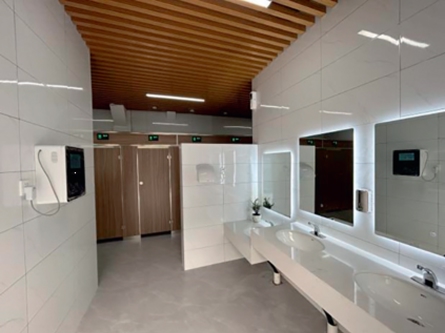
In new construction and renovation projects for public restrooms, our Group actively implements energy-saving and emission-reduction measures. We have taken the lead in advancing smart restroom upgrades in the Nanming District and Butuo projects, having completed renovations on more than 30 facilities to date. We utilize operational data to continuously optimize the functional layout of restroom spaces and focus on selecting advanced water-saving and energy-efficient equipment to enhance management efficiency. We have fully equipped our facilities with sensor-activated faucets to enable automatic on/off control, effectively preventing water wastage. Additionally, we have installed sensor-activated urinal flush systems, significantly reduced water consumption and lowering the risk of pathogen transmission. Regarding lighting system upgrades, the Kunming Wuhua and Xisan projects have adopted high-brightness, low-power-consumption LED energy-saving lamps, complemented by 5W touch-sensitive mirror lights, which have substantially reduced electricity consumption. Through these technological applications, we have not only conserved water resources and reduced electricity costs while improving resource utilization efficiency, but we have also upheld the concept of green operations while ensuring the quality of public services, thereby achieving dual improvements in both economic and environmental benefits.